Breathedge 2 Metal: Where to Find It and What It Crafts
Metal in Breathedge 2 floats as big round chunks near the crashed train and Outskirts. Where to find it, how to harvest it, and every recipe that spends it.
FAQ
What does metal look like in Breathedge 2?
What tool do I need to harvest metal?
Is metal the same as aluminum in Breathedge 2?
Should I convert metal into Refined Metal?
Metal is the material this game refuses to make scarce, and players still run dry — because the four confirmed recipes that consume it all pull at once. This page covers where the chunks float, how the harvest works, and what your stock is realistically spent on, verified against the Early Access launch build.
Where do you find metal in Breathedge 2?
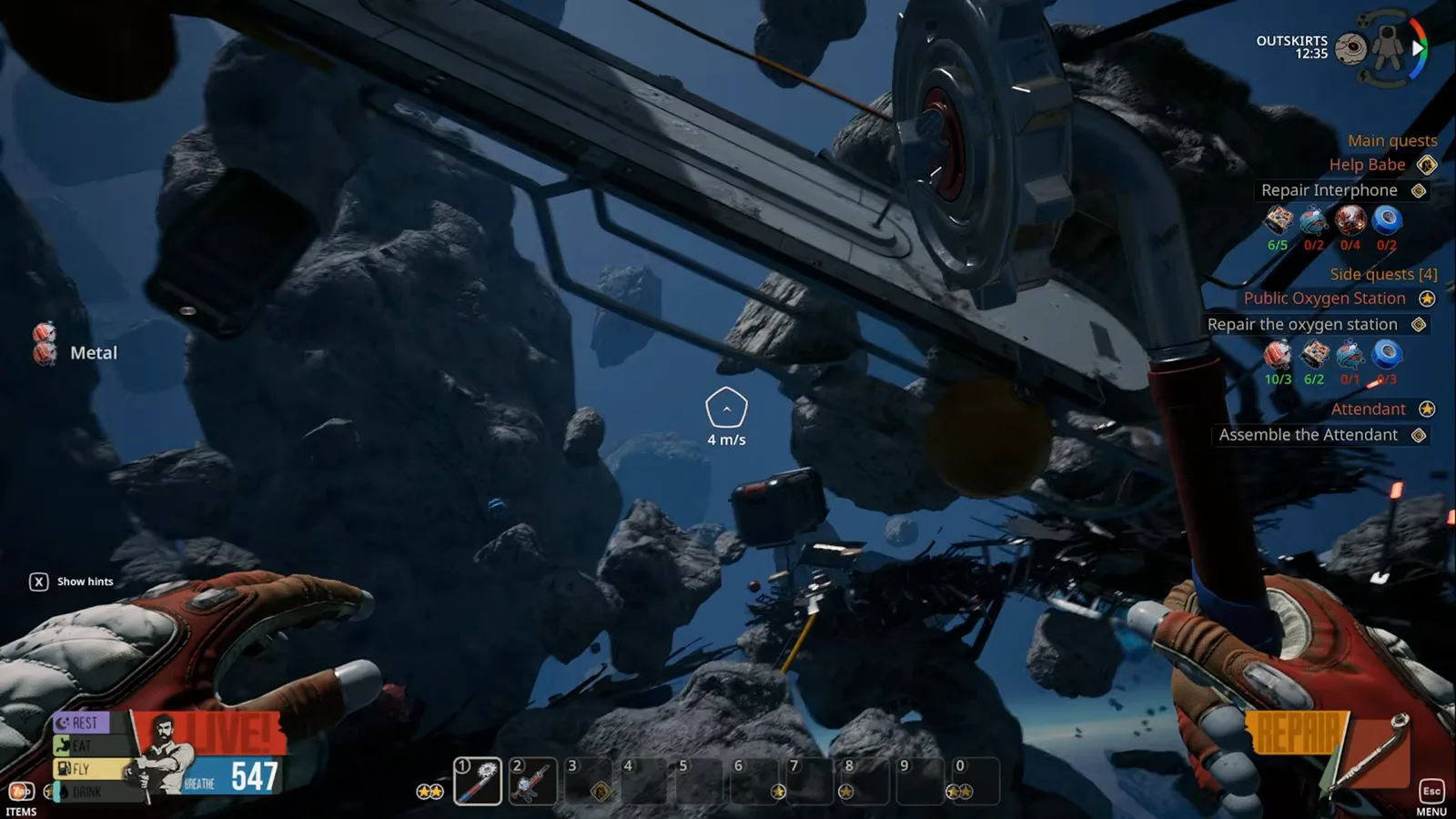
Metal is the most common resource on the Early Access launch build (2026-08-31), and the game is not subtle about it: big circular chunks of, well, metal, hanging in open space. The gameplay reference this site verifies against describes them exactly that way and adds the reassuring part — “you’ll never run out of metal” (01:33).

Gameplay reference — Early Access launch build
The floating balls cluster in three places you already visit:
- Around the crashed train — your home base sits in the middle of a metal field, so the opening minutes hand you units before any objective asks for them.
- Outskirts platforms — the station structures carry chunks alongside the Plastic nodes on their hulls.
- The debris field toward the DEPOT route — the drift corridor of wreckage between the station area and the cold zone is dense with balls, so any trip in that direction doubles as a haul.
Two secondary sources round it out: orange wreckage and pried containers also yield metal, per the material table in the crafting recipes hub. Neither requires a special tool — they are loot objects, not ore.
How do you harvest metal?
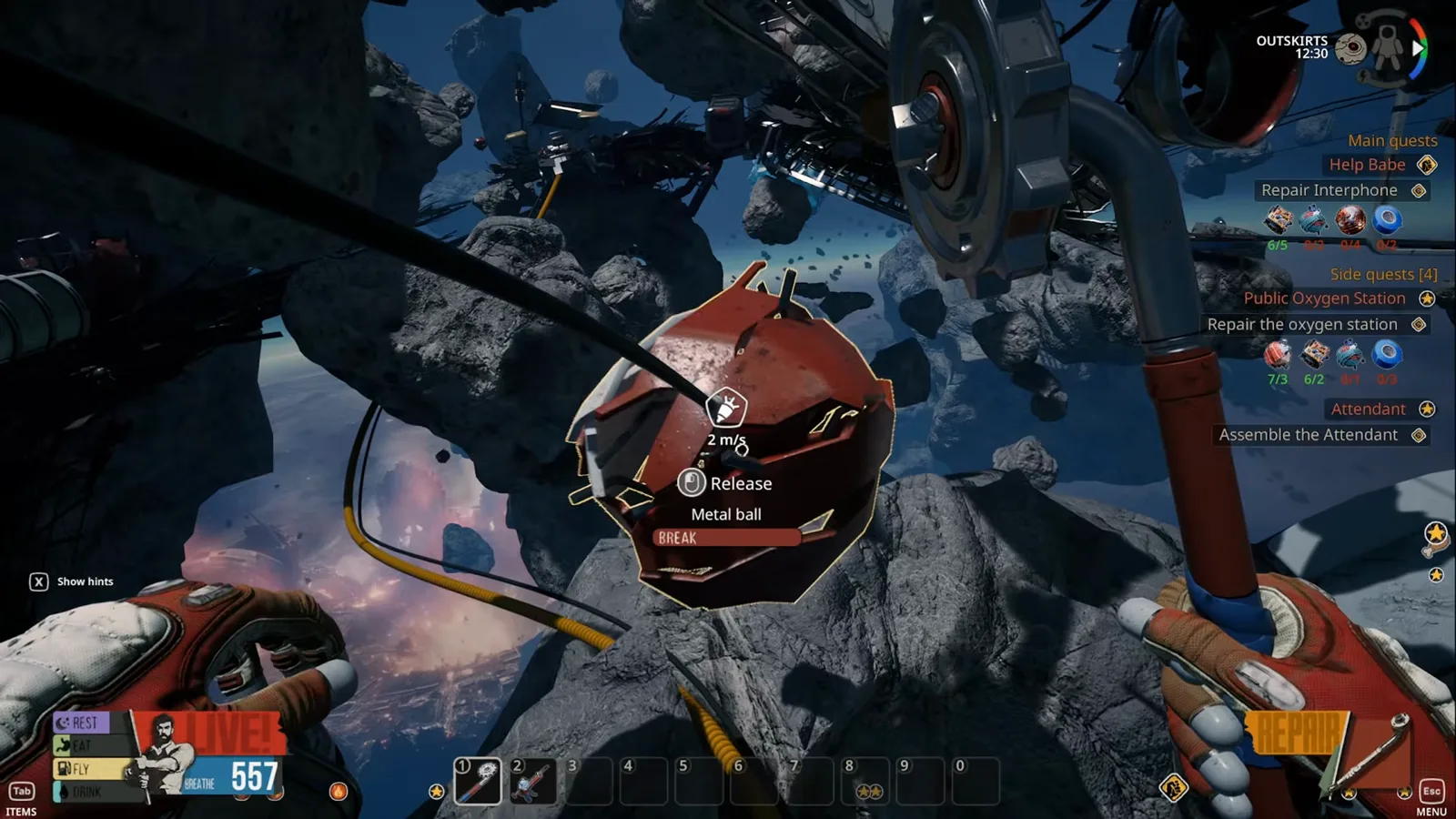
The harvest tool is the Scrap Tool — the crowbar-class impact implement you prototype at the very start. Scavenging in this game runs on five verbs (Break, Cut, Unscrew, Pull, Drill), and metal answers exactly one of them: Break.
The loop, as it plays out in the reference footage (01:36):
- Fly up to a ball and aim at it. The prompt reads Metal ball with a Break bar underneath — if you see Grab, that is a loose pickup, not the ore itself.
- Strike it with the Scrap Tool until the shell cracks. It takes several hits; the sparks are your progress bar.
- Break the shell open and the ball falls apart into loose Metal pieces.
- Grab the drops — each burst ball spills multiple units, which is why a short pass through the debris field fills the counter fast.
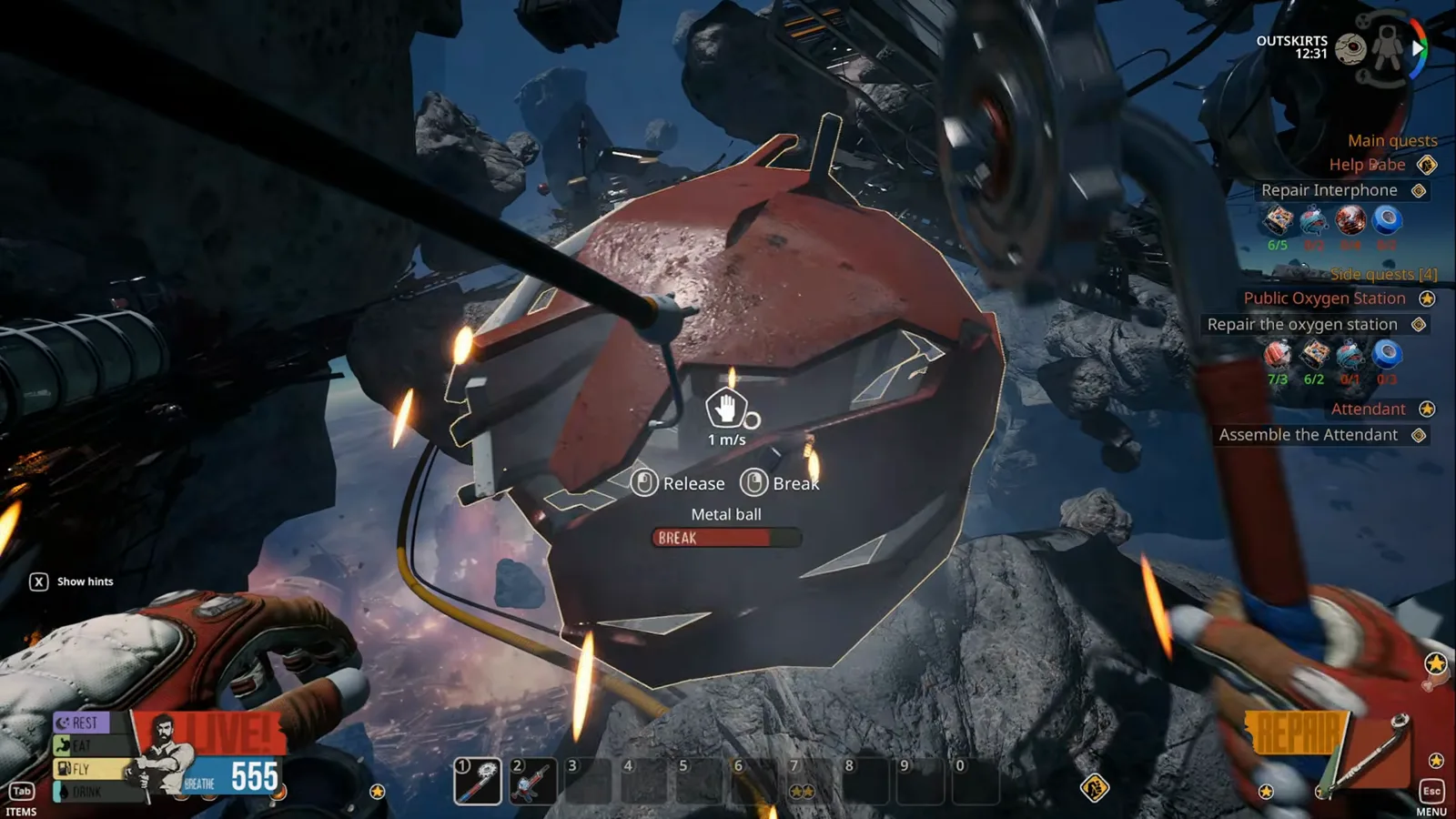
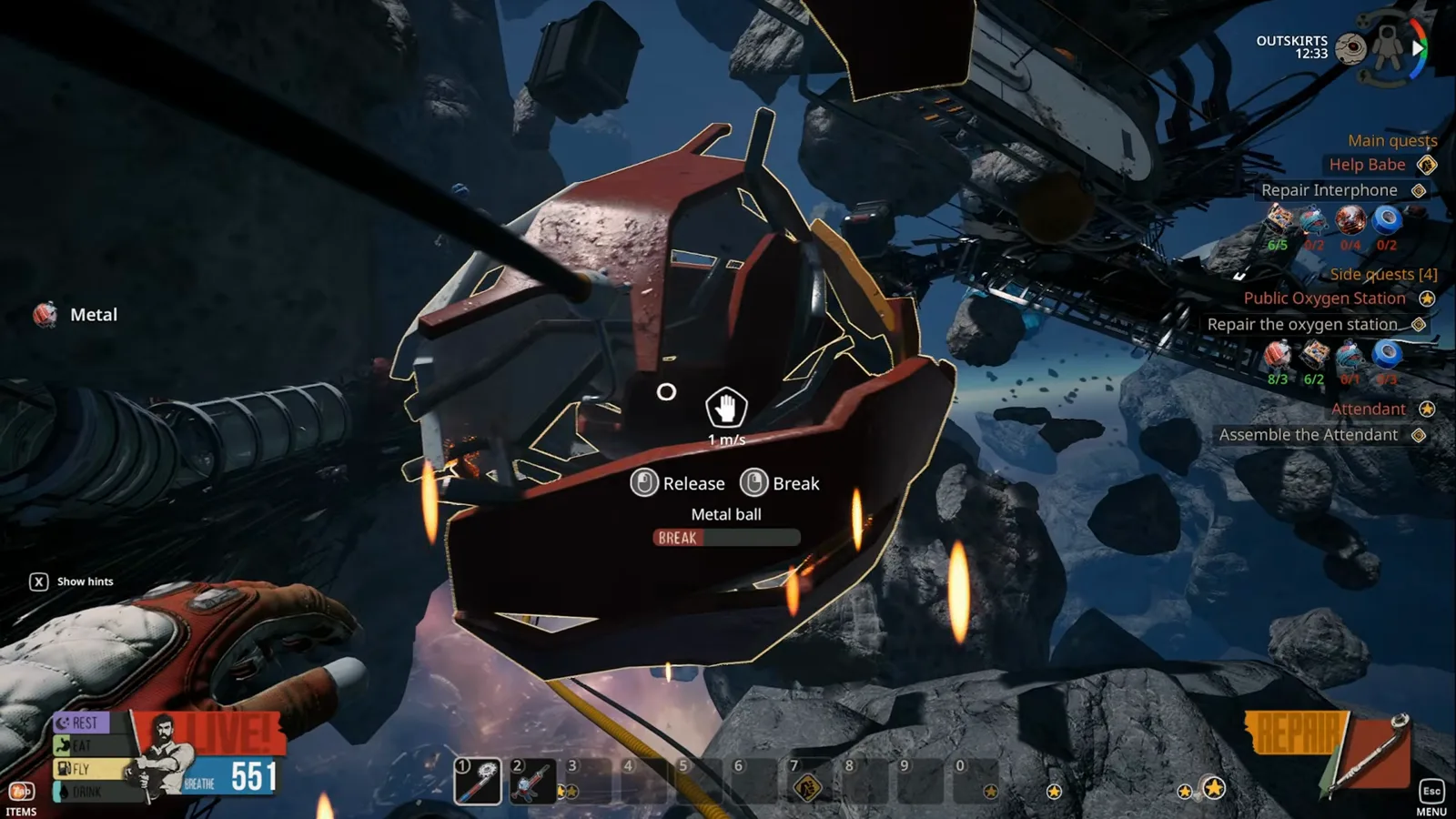
That is the entire technology. No drill, no module, no workstation — which is why the author’s “very easy to get and very common” line holds up: the only gate on metal is whether you stop to hit things on the way past.
What is metal used for?
Only four consumers are confirmed as of the Early Access launch build (2026-08-31), but they all tax the same pocket, and three of them land in your first two hours:
| Consumer | Cost | What you get | Source qualifier |
|---|---|---|---|
| First DIY tool (crowbar-type) | 2 × Metal | Smashes containers and panels | Official example + player test; exact pairing needs a second source |
| Refined Metal | 4 × Metal → 1 × Refined Metal | Feeds deeper industrial builds and gear | Two player walkthroughs agree |
| Purified Oxygen | 2 Oxyworm + 1 Metal + 1 Ice | Restores about 120 oxygen | Player-measured, single run |
| Public Oxygen Station repair | 3 Metal + 2 Electronics + 1 Wire + 3 Electrical Tape | Permanent external refill point in the Outskirts | Player-measured |
Reading the table as a spending order: the first tool comes off the top and unlocks half the game’s loot; the Public Oxygen Station changes how far from the train you can afford to wander — the oxygen locations guide covers where it sits and what the repair needs; Purified Oxygen is the repeatable long-trip consumable. Refined Metal is the only entry to delay, for reasons the next section gets into.
Every formula above is a community measurement or an official example, not an extracted data table — the full picture, including what stays unconfirmed, lives in all confirmed recipes.
Metal vs. Aluminum vs. Refined Metal

The classic early mistake is treating these as one metal family with three skins. They behave nothing alike:
- Metal floats free in open space in ball-shaped chunks and breaks to the Scrap Tool. No gate.
- Aluminum never floats. It sits as pale veins embedded in rock asteroids and answers to no verb except Drill — that gating is precisely why “metal vs. aluminum” confusion is a recurring question. If you are hitting a chunk with your crowbar and nothing happens, you are not looking at metal.
- Refined Metal is a processed tier, not a node you hunt. 4 Metal convert into 1 Refined Metal at the workbench, and it also drops directly from deep industrial equipment and containers.
The 4:1 conversion is the reason to hold off on refining. Early consumers want raw metal — the first tool, the oxygen station, Purified Oxygen — so refining stock before a recipe demands Refined Metal converts four units of everything-proof currency into one unit of a narrower one. Refine on demand, and spend loose Metal first wherever the recipe allows it.
Titanium is the lookalike worth learning too: it drifts through space as spiky balls, not smooth ones. The materials where to find hub keeps the full visual table of every node type, and the smaller hull scavenging that surrounds your metal runs — Plastic bubbles, Electrical Tape on pipes — is catalogued on the Plastic page as well.
How should you farm metal?
You mostly should not — not as a dedicated trip, anyway. The community habit that works:
- Break every ball you transit past, from minute one. The author’s point that the chunks are effectively inexhaustible means the winning strategy is opportunism, not routes.
- Carry the Scrap Tool always. It is your container-smasher too, so it never leaves the active slot anyway.
- Budget around the station repair. If 3 Metal are reserved for the Public Oxygen Station, the rest is free to spend — oxygen planning belongs to the oxygen locations guide, since a dead run wastes every unit you farmed.
- Do not stockpile past need. There is no verified reason to sit on fifty units; the floating supply is the storage.
Metal behaviour and the four confirmed consumers were re-checked on 2026-09-21 against the launch build. This page is reviewed as updates land — it is not auto-updated.
Related Articles
items
Breathedge 2 Duct Tape: Where to Find Electrical Tape
Where to find Electrical Tape in Breathedge 2: duct-taped pipes on station hulls, the Cutter Tool harvest, and the Oxygen Station repair that needs 3 rolls.
items
Breathedge 2 Plastic: Where to Find Plastic Nodes
Plastic in Breathedge 2 hides as bubbly nodes glued to station hulls and as blocks on wire-run ends. What the nodes look like, the Break verb, and the box trap.
guides
Breathedge 2 Base Building: Train Car Modules & Layout
Early Access train base guide for Breathedge 2: Wardrobe, Workbench, Bobby Kettle, and Nutra Pack-O-Mat car modules, life-support loops, and future build plans.
Was this helpful?
Thanks for the feedback!